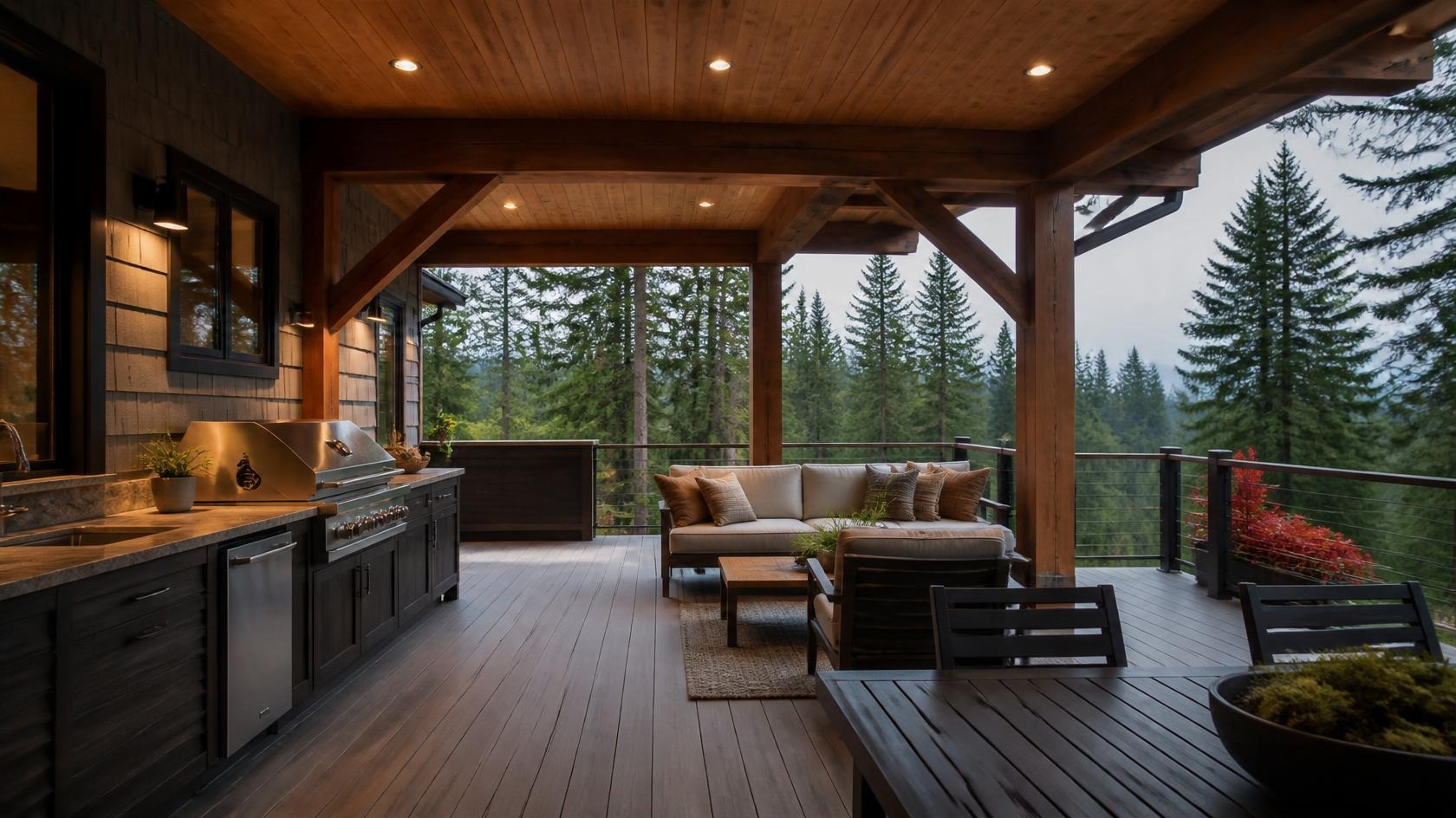
Deck builders sell bigger outdoor living spaces by pitching the whole backyard room on the first site walk: the deck, plus a covered patio, lighting, a cooking area or a screened porch. You show finished projects that look like that, price it in tiers, and market those finished rooms instead of bare boards. That’s how a deck bid turns into a backyard project worth twice as much.
By Carl Jiang, Co-Founder · Last updated October 2026
Most deck contractors we talk to have the same problem. Good builders, decent calendar, and an average ticket that hasn’t moved in years. The homeowner asked for a deck, so they quoted a deck. Nobody asked what the family wanted to do out there on a wet Tuesday in March.
This post is written for the builder. It covers what to offer, how to sell it at the kitchen table, and how to market outdoor living so the bigger jobs start coming to you already half-sold. If you want the broader marketing picture first, start with our deck contractor marketing page.
What counts as an outdoor living space?
An outdoor living space is any built area outside the house that people use like a room. That means shelter, a place to sit, light to see by, and usually a reason to stay: cooking, a fire, a TV, or simply a dry spot to drink coffee. A deck is the floor. Outdoor living is the floor plus the stuff that makes people use it.
For a deck builder, the menu usually looks like this:
- Covered patios and patio covers (solid roof, open sides)
- Pergolas, with or without a louvered or polycarbonate top
- Screened-in porches and three-season rooms
- Outdoor kitchens, from a built-in grill station to a full counter run
- Lighting, heaters, fire tables and power for a TV
- Privacy walls, built-in benches and planters
You don’t have to build all of it. Sub out the electrical, gas or countertops if you want. But be the one selling it, because whoever sells the whole backyard owns the margin.
Why sell outdoor living spaces when you already build decks?
Because the deck alone is the most commoditized part of the job. Every builder in town can frame a 16×20 composite deck, and the homeowner knows it, so they collect four bids and pick the cheapest. Add a roof, lights and a kitchen and you’re no longer comparable line for line. That’s where your margin lives.
In the 2025 Cost vs. Value Report from JLC, the national average wood deck addition runs $18,263 and a composite deck addition $25,096. A backyard patio project averages $51,454. Same homeowner, same backyard, double the ticket.
That same report shows decks recoup a lot at resale (94.9% for wood, 88.5% for composite) while the patio project recoups 46%. I’d lead with that. The deck is the smart money move, and the covered patio, kitchen and lighting are what they’ll actually enjoy for the next fifteen years. People don’t buy outdoor kitchens for resale. They buy them so they can grill in October.
And here in Western Washington, a roof over the deck changes how many months a year it gets used. Around Tacoma, Puyallup and Olympia, an uncovered deck sits wet from about November to April. Cover it, add a heater and some light, and it’s usable most of the year. That’s a sales argument you can make in any rainy market, and it works.
How do deck builders sell a covered patio?
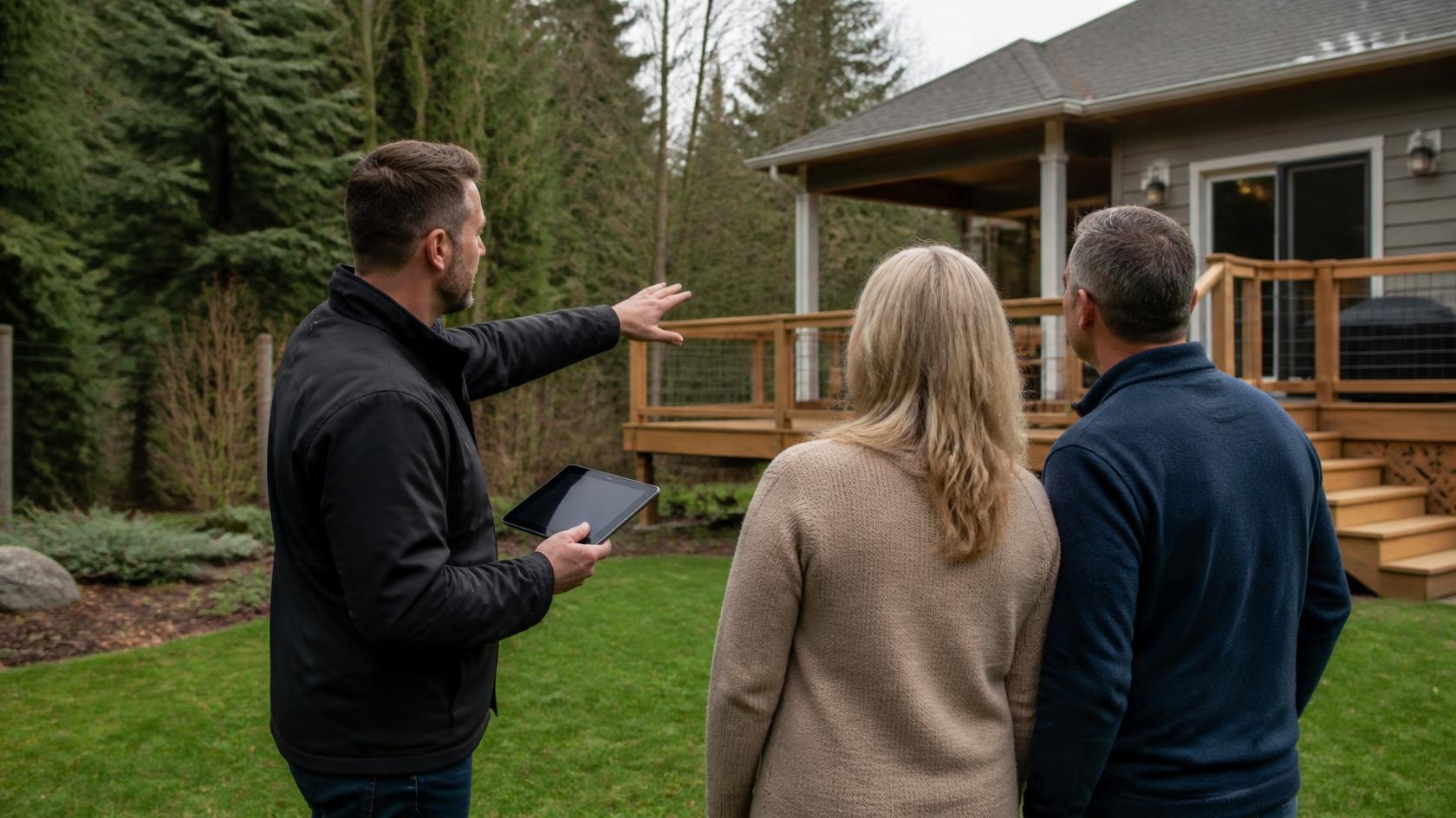
You sell it before the homeowner knows to ask. By the time a client is comparing bids, they’ve already decided what they’re buying. So the covered patio has to come up on the first site walk, with a photo of one you built and a rough price range.
Here’s the site walk sequence I’d use:
- Ask how they want to use the space, not what size deck they want. “Where do you eat dinner in summer? What happens out here when it rains?” Their answers tell you what to pitch.
- Walk to where the cover would go and stand under the roofline. Talk about tie-in, height and where the water goes. Now it’s real.
- Show two or three finished projects on a tablet. Your own work beats a manufacturer brochure every time.
- Price in tiers: deck only, deck plus cover, deck plus cover with lighting and a heater. Anchor on the middle tier; that’s the one you want them picturing.
- Offer phasing. Build the deck now with footings and framing sized for a future roof. A lot of those clients call back the next spring.
Don’t skip step five. A homeowner who can’t swing the whole thing this year can usually swing the deck, and if it’s engineered for the cover, you’re the builder who adds it later. That’s a second job with no ad spend.
Visuals close these jobs faster than talk does. We went deep on renderings, 3D mockups and photo libraries in our post on deck design visuals that close jobs.
Should deck builders offer outdoor kitchens?
Yes, if you can deliver one without wrecking your schedule. Most deck builders shouldn’t try to become kitchen contractors. But a grill station with a counter, storage and a hood or cover is well inside a good crew’s skill set, with subs handling gas, electrical and stone tops.
A few rules before you add it to the menu. Know your local permit triggers for gas lines and outdoor electrical, because that’s where inspections slow things down. Keep the kitchen on a slab or a properly framed section; a loaded stone countertop on standard joist spacing is asking for a callback. And price the appliances separately so the homeowner can see where the money goes.
Crew already booked solid? Then show the kitchen as an option and refer the countertop work out. You keep the deck, the cover and the client.
How do you market patio covers and screened porches?
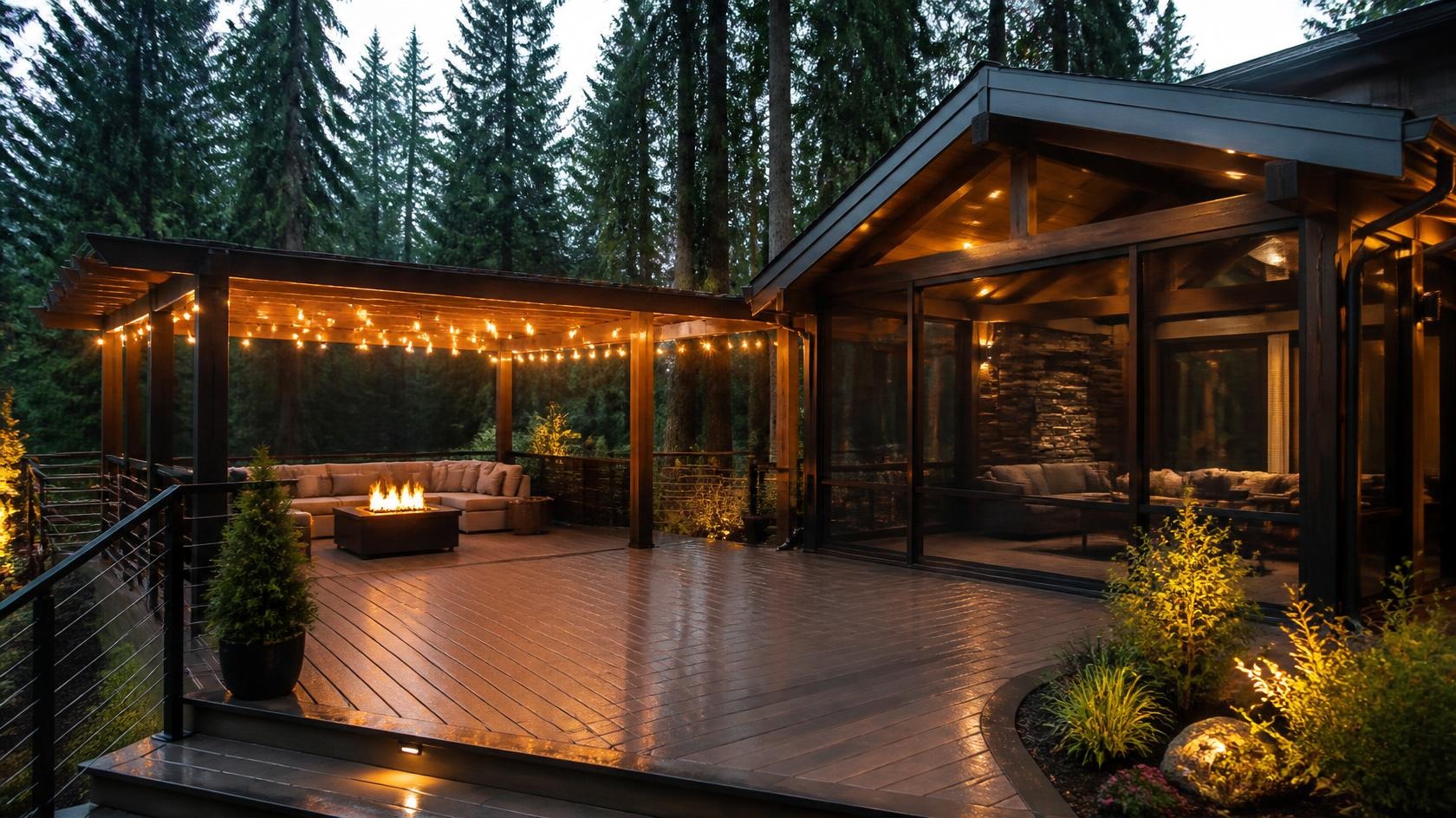
Market the finished room, with people’s real reasons for wanting it. “Covered patio installation” is fine as a page title. But the ad, the post and the photo should show a dry, lit space at dusk with chairs that look used. Homeowners don’t search for joists. They picture evenings.
What that looks like in practice:
- Separate service pages. Give covered patios, pergolas and screened porches their own pages so you can rank for each one. Our guide to SEO for deck contractors walks through the page structure.
- Photos shot on purpose. Go back to finished jobs at golden hour with the lights on. One great dusk photo outsells twenty phone snaps taken at noon.
- Your Google Business Profile. Add patio covers and screened porches as services, and post finished projects there. Here’s how to set up a GBP that gets calls.
- Paid social with real project creative. Meta lead ads with carousel photos of finished rooms work very well for this category.
We’ve seen that last point play out with a client in this exact niche. JB’s Enclosures, a Tennessee company that builds screen rooms, patio covers and carports, started with no website at all. Their first month of Meta lead ads (carousels and boosted posts of finished projects) brought in 73 leads at $29.21 each on $2,132.23 in spend. Three jobs closed straight from that campaign at $35K, $11K and $5.5K. Since starting in March, they’ve brought in more than $800K in projects.
What results look like for builders who market the whole backyard
Empire Home Solutions in Cincinnati builds custom decks and patios, plus additions and roofing. From March through May 2025, a Meta lead-form campaign aimed at homeowners interested in exterior remodeling produced 109 qualified leads at $28.64 each on $3,122.17 in spend. Within two months they were booked out for the year. Even after raising their prices.
Some quick numbers to keep in your pocket for the kitchen-table conversation:
| Project (2025 national average) | Job cost | Cost recouped at resale |
|---|---|---|
| Deck addition, wood | $18,263 | 94.9% |
| Deck addition, composite | $25,096 | 88.5% |
| Backyard patio | $51,454 | 46% |
Source: JLC’s Cost vs. Value Report 2025. Your local prices will differ. Use them to frame the conversation.
If your leads are fine but nobody’s following up, that’s a different fix. Our pay-per-appointment program pairs the ads with human appointment setters, and you pay for booked estimates. For premium decking upsells specifically, see how we pitch AZEK vs Trex vs TimberTech to homeowners.
Where we work with deck builders
Zeal Media Solutions is based in Washington State and works with home improvement contractors nationwide, from Everett and Tacoma to Tennessee, Ohio, California and Texas. We take one contractor per trade per service area, so we’ll never run outdoor living campaigns for two deck builders competing for the same homeowners. Want to see what’s open in your market? Check our deck contractor marketing services.
Zeal Media Solutions
Washington, United States
Phone: (928) 482-6963
Local SEO, Google and Meta ads, pay-per-appointment and websites for deck builders and home improvement contractors nationwide.
Frequently asked questions
How much does an outdoor living space cost?
It depends wildly on scope. A cover over an existing deck can be a five-figure job, while a deck, roof, kitchen and lighting package can run well past $50K. JLC’s 2025 national average for a backyard patio project was $51,454, which is a decent gut check.
Does a pergola add value to a home?
Think of it as adding use and curb appeal first. What it does for resale depends on the house and the market. Sell it as the thing that makes the deck feel finished. Homeowners get that right away.
Are sunrooms worth offering?
Only if you’re set up for it. A true sunroom is closer to an addition, with foundations, insulation, windows and often HVAC, and permitting to match. Most deck builders do better with screened porches and three-season rooms and refer full sunrooms out.
What is a typical covered patio project size?
Most covers match the deck or patio underneath, so the footprint is set by what’s already there and how the roof ties in. Something in the range of 12×16 up to 16×20 feet is a common starting point for attached covers. Bigger yards go bigger, of course.
How should I photograph outdoor living projects?
Go back after the job is done, at dusk, with every light on and furniture in place. Shoot wide from the yard and then from inside the house looking out. Skip the noon phone photos; they make a beautiful room look like a parking lot.
Ready to fill next season with bigger outdoor living jobs instead of bare-deck bids? Book a Free Strategy Call and we’ll show you what’s working for deck builders in your market.