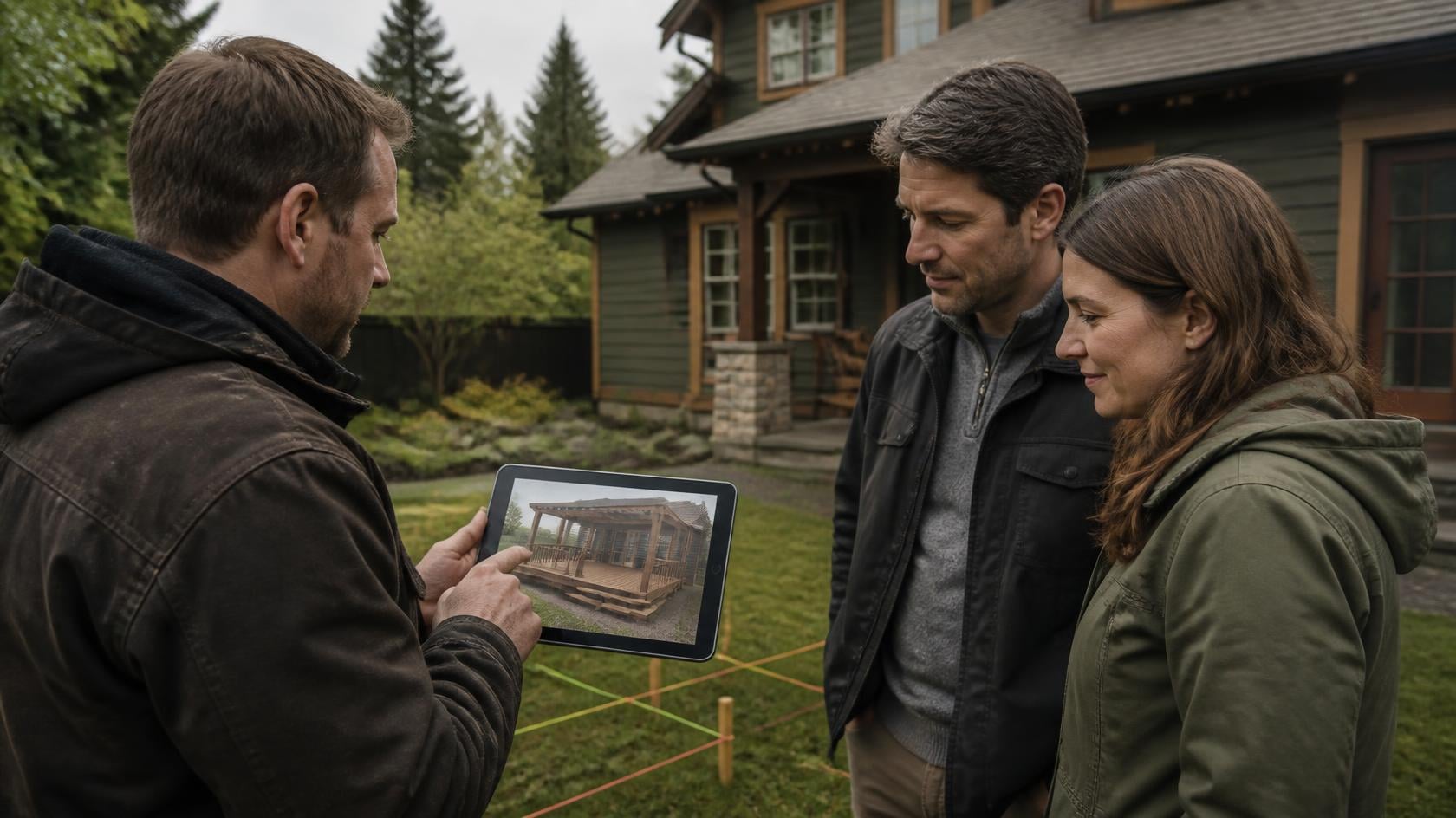
Good deck design sells the job before you quote it. Show the homeowner a scaled plan and a 3D view of their own house at the estimate, give them two or three options at different price points, and settle materials and railing on the spot. Deck builders who do this close more estimates and argue less about change orders. Here’s how to build that into your sales process.
By Carl Jiang, Co-Founder · Last updated September 2026
We work with deck builders all over the country, and the ones with full calendars don’t always have the best crews. They have the best presentation. Homeowners can’t picture a 16 by 20 composite deck with a picture-frame border by staring at a patch of lawn. You can. Your job at the estimate is to close that gap, and the tool for that is the design you put in front of them.
This post is written for you, the contractor. Homeowners browsing deck ideas at 11 pm are welcome, but I’m talking to the person holding the tape measure.
How should deck builders present a deck design?
Present it in person or on a video call, on a tablet or laptop, with the homeowner’s actual house in the picture. Start with the layout. Then walk through it from the back door out, the way they’ll use it. Save price for the end, after they’ve pictured themselves grilling on it.
The order matters more than people think. I’d run it like this:
- Recap what they told you. Hot tub pad, afternoon shade, stairs to the yard.
- Show the plan view with dimensions so they understand the footprint.
- Switch to the 3D view and spin it. Stand them “at the slider” and look out.
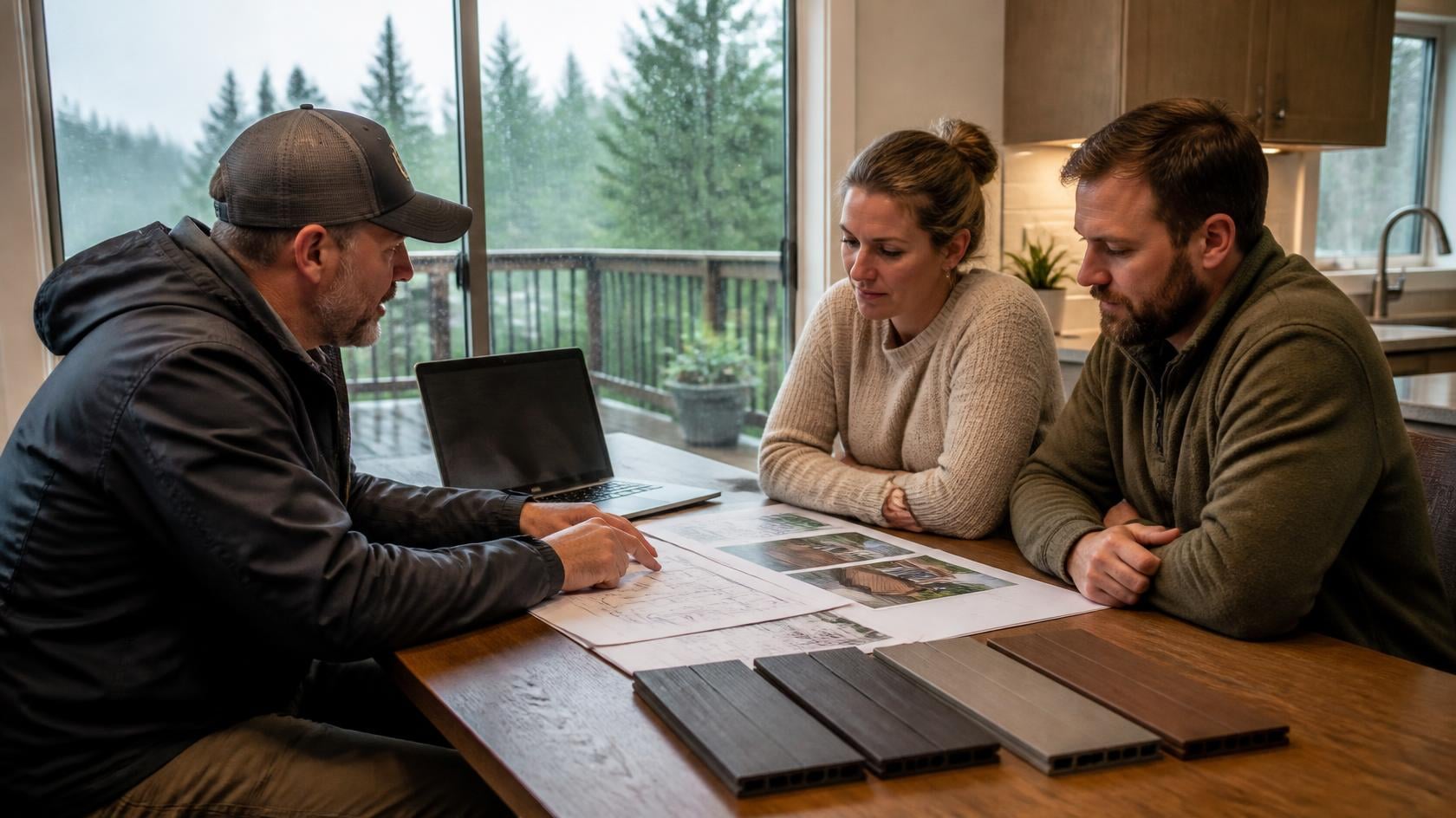
- Show two or three versions. A good, a better, a best. Maybe one with a lower level or built-in bench.
- Lay physical samples on the table: decking boards, a railing baluster, a post cap.
- Then talk price, and tie each tier back to the version they just saw.
Why tiers? Because a single number invites a yes or no. Three options invite “which one.” That’s a much better conversation to be in. And leave the design with them, so a spouse who missed the appointment can see it.
What does a deck designer do?
A deck designer turns a homeowner’s wish list into a buildable plan: layout, levels, stairs, framing, footing locations, material and railing choices, and drawings good enough for a permit and a crew.
So should that be you? Depends on volume. If you’re running one crew and closing a few decks a month, doing your own deck designs keeps the relationship tight and costs nothing but time. Once you’re running multiple crews, the owner-as-designer model starts to break. Estimates stack up, drawings slip, and the homeowner who was excited last Tuesday has already signed with someone faster.
A few signs it’s time to hand design off:
- You’re more than a week behind getting plans back to people you’ve already met.
- Permit sets keep getting kicked back for missing details.
- You’re designing on weekends and still losing jobs to slower follow-up.
A hired designer (or a drafting service) usually pays for itself in estimates that don’t go cold. But keep yourself in the sales meeting. Homeowners buy the builder, and they want to shake your hand.
Which deck design software makes sense for a deck builder?
There’s no single best tool. It comes down to how you sell. Here’s how I’d think about the main options.
| Tool type | Examples | Good for | Watch out for |
|---|---|---|---|
| Manufacturer deck designers | Trex, TimberTech and Fiberon online designers | Fast visuals with real board colors | Locked to one brand, limited framing detail |
| General 3D modeling | SketchUp | Custom shapes, multi-level decks, photo-matched views | Learning curve, slow at first |
| Residential design suites | Chief Architect | Permit-ready plans, framing, material lists | Cost and training time |
| Outdoor-living 3D suites | Structure Studios (VizTerra) | Full backyard renders with lighting and landscaping | Overkill for simple ground-level decks |
My blunt take: pick one and get fast at it. A mediocre render you can build in 30 minutes beats a gorgeous one that takes three days, because the three-day version reaches the homeowner after your competitor’s did.
Do 3D deck designs help close sales?
In our experience, yes. And the reason isn’t the pretty picture. A 3D view kills the vague worry that stops people from signing, the “what will it look like off the kitchen” question. Once they’ve seen it, the decision gets smaller. Now it’s about which version.
It also protects you later. When a homeowner has signed off on a drawing that shows a 42-inch railing and three steps, there’s no argument in week two about why the steps aren’t where they pictured them. Clear deck plans are the cheapest change-order insurance you’ll ever buy.
And the market’s there. The 2026 U.S. Houzz Outdoor Trends Study found decks were the most common outdoor structure upgrade, at 43% of homeowners who upgraded structures, and that 71% of homeowners hired a pro for outdoor work, up from 65% in 2024.
How detailed should deck plans be at the estimate stage?
Detailed enough to price accurately and let the homeowner picture it. Not so detailed that you’ve given away a free permit set to someone who might hire the cheapest bid. Here’s where I’d draw the line.
At the first estimate, show footprint and dimensions, levels and stair locations, decking material and color, railing style, and any add-ons like lighting or a privacy wall. Leave out framing plans, footing schedules, beam sizing and the engineered details. Those come after the deposit.
That’s also your answer to whether you should charge for design. A lot of builders run it like this: concept visuals are free as part of the estimate, and full construction drawings are a paid step (often credited back against the contract). It filters out the tire-kickers who want a free plan to hand to their brother-in-law, without scaring off serious buyers.
Where do homeowners get deck ideas?
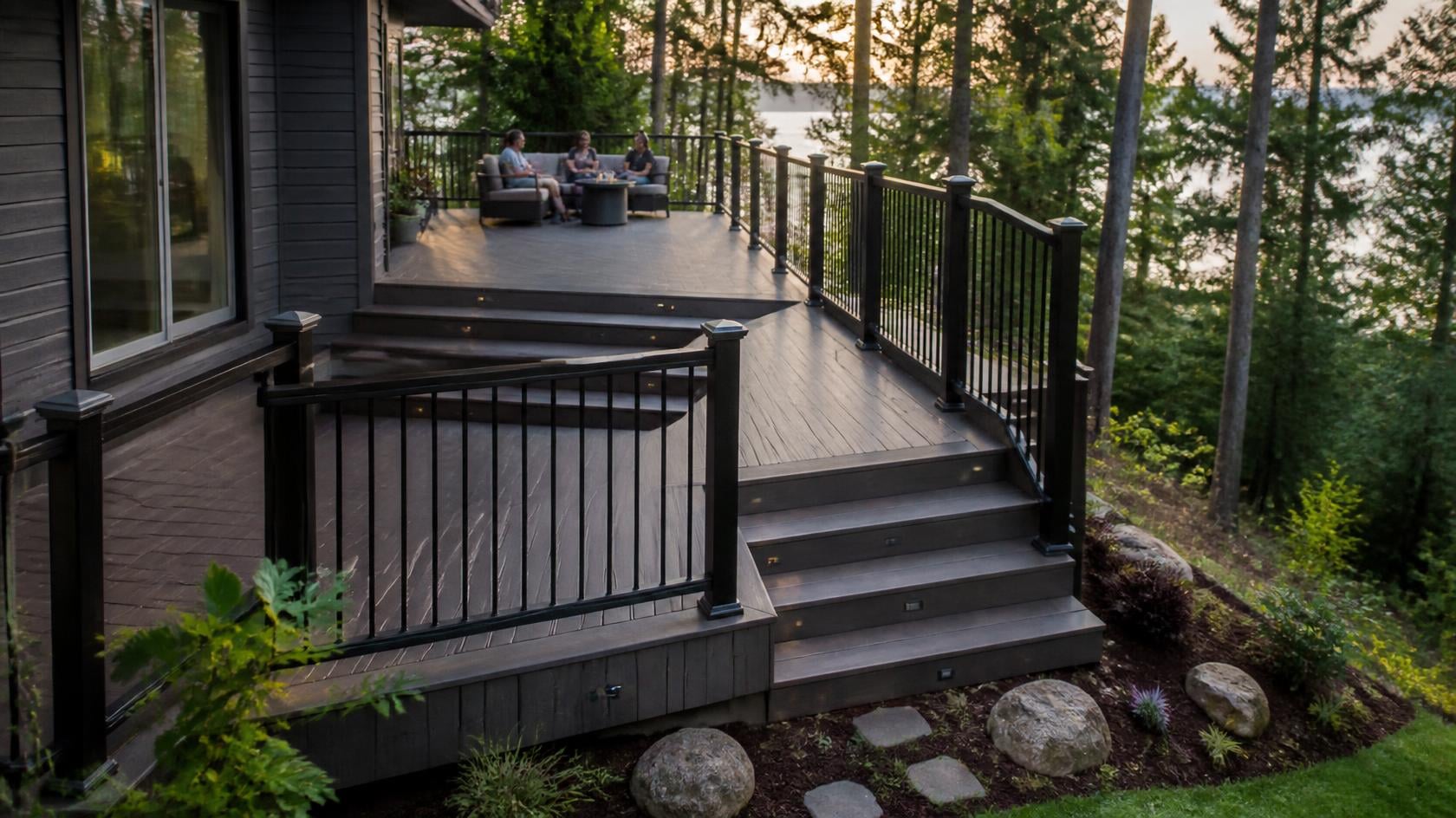
Mostly online, long before they call you. Pinterest, Houzz, Instagram, manufacturer galleries, and Google image results for “deck ideas.” They also get them from the neighbor’s new deck. Which means your job photos are competing with every staged photo on the internet.
So use it. When a homeowner shows you a screenshot, don’t dismiss it. Ask what they like about it. Usually it’s one thing: the lighting, the dark railing, the wide stairs. Then design that into their version and say so out loud.
In rainy markets like Tacoma, Puyallup and Olympia, covered sections are an easy sell, and low-maintenance composite, built-in lighting and multi-level layouts on sloped lots come up constantly. The Houzz data backs up the shade trend, too: shade structures jumped 15 points to 35% of structure upgrades. If you aren’t offering a covered option, you’re leaving money on the table.
How to turn your deck designs into marketing
Here’s what most deck builders miss. The design you made to close one job is also the best ad you’ll run for the next ten. A render next to the finished-deck photo is the most persuasive before-and-after in the trade.
We’ve seen what strong visuals do in paid campaigns. JB’s Enclosures, an outdoor-living company in Tennessee, ran a Meta lead campaign built on carousel creative with high-quality project visuals. They got 73 qualified leads at $29.21 each in 30 days, and three jobs worth $35K, $11K and $5.5K closed directly from it (read the JB’s Enclosures case study). Empire Home Solutions, a Cincinnati deck and patio builder, pulled 109 qualified leads at $28.64 over three months and was booked out for the year within two months (see the Empire case study).
A few ways to put your deck designs to work:
- Post render-to-reality pairs on Facebook and Instagram. Our social media team builds whole content calendars around these.
- Add a “design process” section to your website so people know what they’ll get at the estimate. If your site can’t show that off, look at a site built for contractors.
- Use the pairs in ad creative. More on that in our Facebook ads for contractors guide.
- Upload finished projects to your Google Business Profile with the city in the description. It feeds SEO for deck contractors too.
If you’d rather not run all of that yourself, our deck contractor marketing program does it for you. We handle the ads, the site and the follow-up, and with our pay-per-appointment option you pay for booked estimates instead of clicks. Human appointment setters call your leads, qualify them and put the estimate on your calendar. You show up with the design. And we take one deck builder per service area, so we’re never marketing your competitor. For the bigger picture, see our deck contractor marketing guide.
Washington, United States
Phone: (928) 482-6963
Marketing for deck builders and home improvement contractors nationwide, from Washington State.
Frequently asked questions
Should deck builders charge for deck design?
Most builders give the concept visuals away at the estimate. Then they bill for the permit set and credit it back if the homeowner signs. That keeps serious buyers happy and weeds out plan shoppers.
Which deck ideas are homeowners asking for right now?
Covered or shaded areas, dark metal railing, composite boards that don’t need staining, lighting built into stairs and posts, and split levels on sloped yards. In the Pacific Northwest, the roof over part of the deck comes up a lot.
Do homeowners want deck plans before signing?
They want to see it, sure. A layout and a 3D view usually does the trick. Most don’t need framing details to say yes, and you shouldn’t hand those over until there’s a deposit.
How detailed should deck designs be at the estimate stage?
Enough to price it and help them picture it: size, levels, stairs, materials, railing, extras. Keep structural details for after the contract. If you’re spending hours on plans for people who haven’t committed, you’re overdoing it.
Should a deck builder hire a deck designer?
Once design work is slowing down your follow-up, probably. A freelancer or drafting service is a cheap way to test it. Stay in the sales meeting yourself, though, because homeowners want to meet the person building it.
Want more homeowners in front of your deck designs? Book a Free Strategy Call and we’ll show you what a full calendar looks like in your market, or check out our deck contractor marketing service first.