
Local Services Ads for contractors are the pay-per-lead listings that sit at the very top of Google, above the regular search ads, with a Google Verified badge next to your name. You pay for a call or message instead of a click. For most trades they’re worth running, as long as someone answers the phone fast. Zeal Media Solutions runs contractor lead generation nationwide from Washington State.
By Carl Jiang, Co-Founder · Last updated September 2026
Google has changed local services ads a lot in two years. The green Google Guaranteed check is gone. So are manual lead disputes. Much of what contractors read about LSA online is out of date, and some of it will cost you money. Here’s how it works today.
What are Local Services Ads?
Local Services Ads are Google’s pay-per-lead ad format for service businesses. When a homeowner searches something like “roofer near me” or “deck builder Tacoma,” a short row of verified local pros shows at the top of the page with their star rating, review count and hours. The homeowner calls, messages or books right from that listing, and you pay for that contact.
You don’t write ads or pick keywords. You tell Google your job types, service area and hours, and Google decides when to show you. To get in, you pass Google’s screening: background checks, license and insurance verification depending on your trade and state, plus a verified Google Business Profile, which Google started requiring in late 2024.
How does Google LSA charge contractors?
Google charges per valid lead. A lead is an answered phone call where you talk to the customer, a message, a voicemail, a booking request, or a missed call that you then return. Price per lead depends on your trade, your market, the job type and whether the lead came in as a call or a message. Message leads usually cost less than calls.
You control spend with two levers. First, an average weekly budget. Second, a maximum bid per lead, or you let Google set bids with its “Maximize Leads” option. Hit your monthly maximum and your ad stops showing until next month. So when someone says “LSA dried up in week three,” it usually didn’t. The budget ran out.
Here’s roughly how Google sorts what you get billed for:
| Usually charged | Usually not charged |
|---|---|
| Answered call with a real conversation | Someone just asking for advice or a price check |
| Text message or email from a customer | A canceled booking |
| Voicemail, callback request or booking request | A customer who never responds |
| A missed call you return by call, text or email | Contacts that come in outside your business hours |
Notice that last row. Set your hours to when someone can really pick up.
I won’t quote a national cost per lead. A gutter cleaner in a small town and a roofer in a big metro are too far apart for one number to help. Use Google’s signup estimate for your zip codes, then check it against your own numbers after 30 days.

What is Google Guaranteed, and what replaced it?
Google Guaranteed was the green check badge that came with a money-back promise to homeowners if they weren’t happy with work booked through the ad. In late 2025 Google folded Google Guaranteed, Google Screened and License Verified into one badge called Google Verified, and dropped the money-back guarantee. Google only takes reimbursement claims for services booked before December 7, 2025.
Old badge holders moved over automatically. New advertisers earn it through the same screening.
So the badge isn’t an edge anymore. Every pro in the ad unit has the same check mark. What separates you from the contractors beside you is your rating, your review count and how fast you pick up.
How do you rank higher in Local Services Ads?
Google publishes its LSA ranking factors, and they’re more practical than most people expect. There’s your bid, of course. After that it’s responsiveness (missed calls count against you), how relevant your job types and service area are to the search, whether you’ve turned on messages and bookings, and profile quality: your rating, number of reviews, average response time, photos and completed verification checks.
Almost none of that is about money. Here’s the order we’d work in:
- Answer the phone. Every missed call hurts your responsiveness score, and a missed LSA call is often a homeowner who’s already dialing the next pro on the list.
- Turn on message leads and bookings.
- Build review volume steadily. A slow trickle every week beats a burst once a year. Here’s how contractors get more Google reviews without nagging.
- Upload real job photos of your crew and finished work.
- Only then raise your bid, if volume is still too low.
How do you dispute bad leads in Google LSA now?
Mostly, you don’t. Google phased out manual lead disputes in 2024 and replaced them with automated lead credits. Its models screen each lead, skip charging the invalid ones, and reassess charged leads over time. If a lead later looks low quality, a credit usually shows up within about 30 days. The original charge still appears on your invoice, so don’t panic when you see it.
You can still rate leads. In your LSA account, open Leads and use “Rate this lead” so Google learns what junk looks like for you.
But the bigger lever is prevention. If a lead matches the job types and area you told Google you serve, don’t count on getting that money back. So:
- Turn off every job type you don’t want. If you hate small repair calls, switch them off.
- Set your service area by the zip codes you’ll drive to, not the whole county.
- Rate every lead, good and bad, at least once a week.
- Log what each lead turned into in your own CRM. Google can’t see which calls became jobs. You can.
We see this constantly. A contractor complains about garbage LSA leads, and every job type in the category is switched on. Tighten the settings first. Then judge the platform.
Are Google Local Services Ads worth it for contractors?
For most trades, yes, as a baseline. You sit at the top of the page, pay only when someone reaches out, and setup is light.
But know the tradeoffs. You get little control over who sees you. There’s no landing page, so the homeowner judges you on a rating and a review count. Your competitors sit right beside you, and plenty of homeowners call two or three of you.
The math is simple. Divide your cost per lead by the share of leads that book an estimate, then by your close rate. That’s your ad cost per signed job. Small next to your average ticket? Keep going.
Local Services Ads vs Google Ads for contractors
Run both if the budget allows. LSA gives you a steady floor of calls with little work. Search ads give you your own keywords, copy and a landing page built for one service, which is how you scale big jobs like roof replacements or large decks.
Funding only one? Pick LSA if your reviews are strong and your phone gets answered. Pick search ads if your review count is thin or you need to push one service. Budgets and setup are in our guide to Google Ads for contractors.
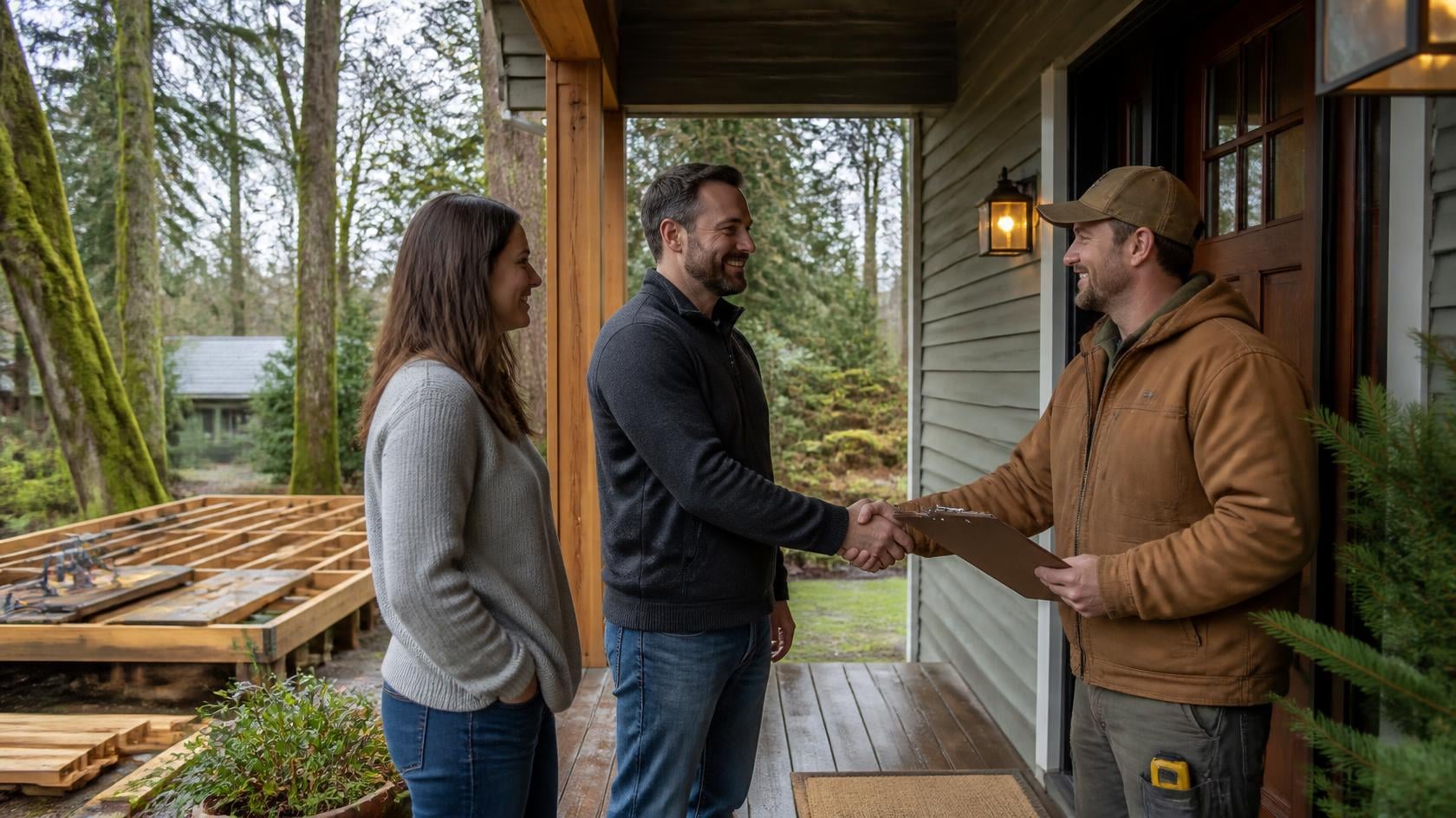
Where pay-per-appointment fits
LSA sells you a lead. A lead still needs someone to call it back, qualify it and get it on the calendar. That gap is why we built our pay-per-appointment program.
We run the ads. Human, U.S.-trained appointment setters call every inquiry within five minutes, follow up by text for several days, and confirm a homeowner and decision-maker with a real project, timeline and budget in your area. Then they book the estimate onto your calendar and handle reminders. You pay per booked estimate. A no-show gets credited to the next one. And nobody resells that homeowner to three other contractors.
Want proof the front end of that funnel works? Look at two of our Meta ad campaigns. These weren’t LSA. JB’s Enclosures in Tennessee got 73 leads in 30 days at $29.21 each, and closed three jobs worth $51,500 from that month’s ads. Empire Home Solutions in Cincinnati got 109 qualified leads over three months at $28.64 per lead and was booked out for the year within two months.
Plenty of contractors keep LSA running alongside it. If you’d rather stop paying for calls you have to chase, see how pay-per-appointment works and whether your trade qualifies.
Where we run contractor lead campaigns
We’re based in Washington State and work with home improvement contractors across the country. In Washington our clients run from Everett and Lake Stevens down through Seattle, Tacoma, Puyallup and Olympia, with others in Vancouver, WA, Ohio, Tennessee, California, Texas and Arizona. We take one contractor per trade per service area, so you’re never bidding against another Zeal client.
Washington, United States
Phone: (928) 482-6963
Pay-per-appointment, Google and Meta ads and local SEO for home improvement contractors nationwide.
Frequently asked questions
How much do Local Services Ads cost per lead?
It depends on your trade, your zip codes and whether the lead is a call or a message. Messages usually run cheaper. Use the estimate Google gives you at signup as a starting point, then trust your own 30-day numbers over any national average.
How does a contractor get the Google Guaranteed badge?
You can’t anymore, at least not under that name. Google swapped it for the Google Verified badge in late 2025. You earn it by passing the LSA screening, which covers background checks and, for many trades, license and insurance checks.
Why am I not getting leads from Google LSA?
Check the boring stuff first: a budget that runs out early, a low bid, narrow hours. Missed calls and thin reviews push you down too, so fix your answer rate before raising the bid.
Do reviews affect Google Local Services rankings?
Yes. Google lists your rating and number of reviews as part of profile quality, right next to response time and photos. A steady flow of new reviews is one of the few ranking inputs you fully control, so ask after every finished job.
Can I pause Local Services Ads in the slow season?
Yes, anytime, from your LSA account. I’d usually lower the weekly budget instead of switching it off, so the account stays active. Pause when the crew is booked solid and you can’t take another estimate.
Want a second opinion on your LSA account, or a plan that fills the calendar with booked estimates instead of raw calls? Book a Free Strategy Call.