SEO for deck contractors comes down to a few settings most companies get wrong. Set your Google Business Profile primary category to Deck Builder. Hide your physical address so the map pack treats you as a service-area business. Then push your review count past the industry median of three. We do this for deck and outdoor-living companies nationwide, out of Washington State.
By Carl Jiang, Co-Founder · Last updated September 2026
Most articles on SEO for deck contractors are the same generic checklist with “deck” pasted over “roofing.” I’m not doing that here. The North American Deck and Railing Association ran a nationwide study of 7,249 deck-builder Google listings, and its benchmark numbers explain most of why a few deck companies show up and the rest don’t. I’ll lean on those numbers throughout, plus what we see running this work for contractors.
One caveat. NADRA published that study in 2020, when the product was still called Google My Business. The category and review benchmarks have held up remarkably well in the accounts we manage, but treat them as directional. Don’t trust them to the decimal.
Why is my deck company not showing up on Google?
Usually it’s one of three fixable things. The listing was never claimed. The primary category is wrong. Or there aren’t enough reviews to clear the prominence bar. NADRA found 29% of deck-builder listings were unclaimed entirely, over 27% had no website linked, and roughly 2% didn’t even list a phone number. Check those before you do anything clever.
The category problem is the expensive one, and nobody notices it. Google offers a bunch of categories a deck company could plausibly pick (Deck Builder, Dock Builder, Fence Contractor, Landscaper, Patio Enclosure Supplier, Carport and Pergola Builder) and the primary one carries a lot more ranking weight than the other nine slots. NADRA found 39% of deck builders use Deck Builder as their primary category. Another 13% sit on General Contractor and 11.5% on Construction Company.
So roughly a quarter of deck companies are filed under something broader. They’re competing against every remodeler and framer in the county instead of the handful of real deck builders. If you build decks and also do fences or pergolas, pick the primary slot based on which search you want to win. It doesn’t have to describe everything you do. Google’s own category guidelines say outright that additional categories are there for the secondary work.
Then there’s review volume. The bar is almost comically low. 61% of deck-builder listings have three or fewer reviews, a third have none at all, and the average sits at about 9 reviews and 4.4 stars. Get to double digits and you’re ahead of most of your market. But watch the rating too. That 4.4 average lands just under the 4.5-star line where a meaningful share of homeowners stop considering a business, so quality counts as much as volume.
How do deck contractors rank in the local map results?
The map pack looks at relevance (does your category and content match the search), proximity (how close you are to the searcher) and prominence (reviews, links, general reputation). You control relevance and prominence. Proximity mostly isn’t yours to control, though one setting changes how it gets calculated.
Most deck builders work out of a shop, a yard or a home office, and they meet every customer at the customer’s property. If that’s you, hide the address and set the profile up as a service-area business. NADRA found 41% of deck builders had hidden their address, which means most hadn’t. A visible home address in a residential ZIP pins you to a spot with no customers around it. Hide it and you get to define a service area instead.
Two practical notes from doing this over and over:
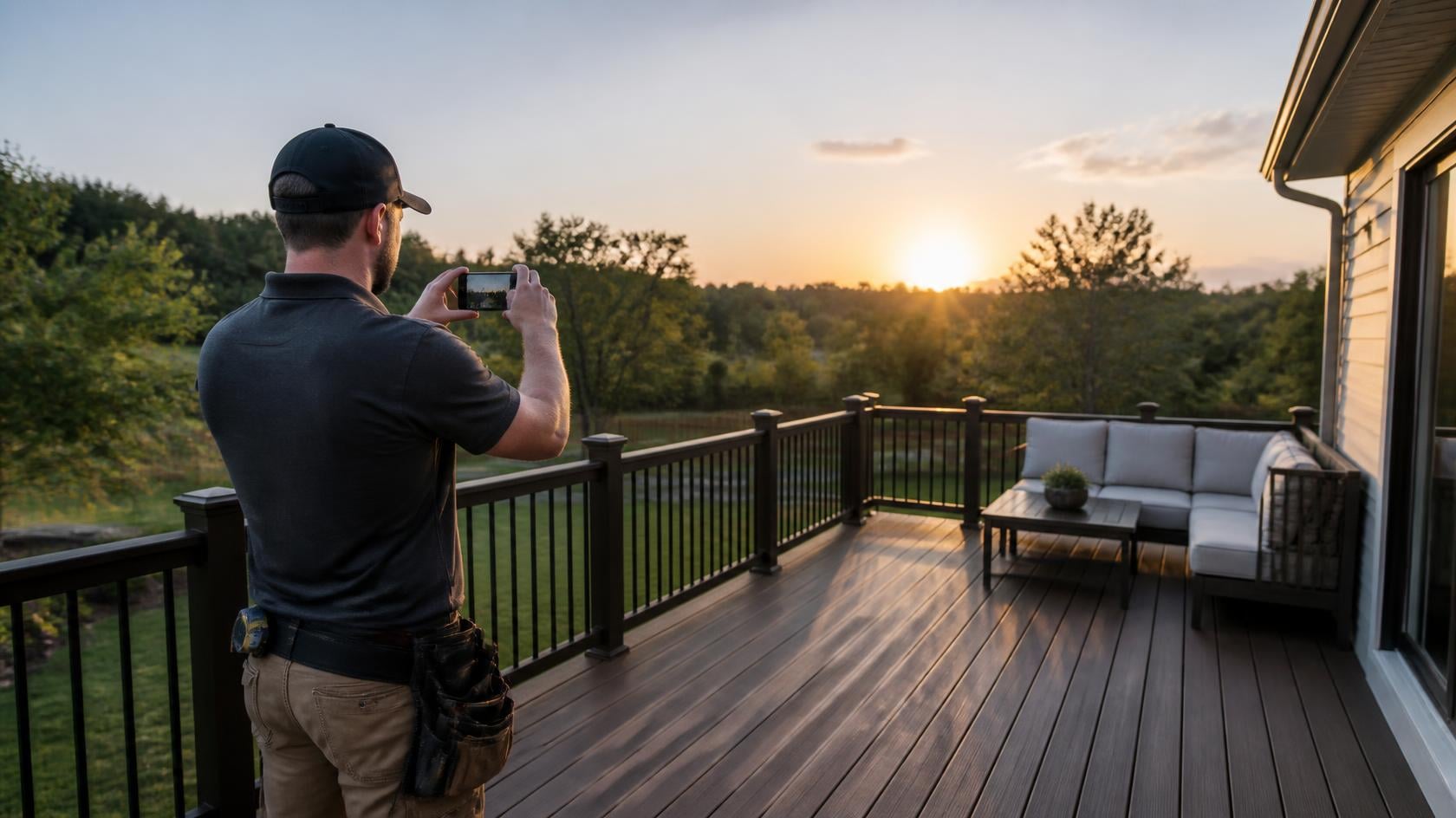
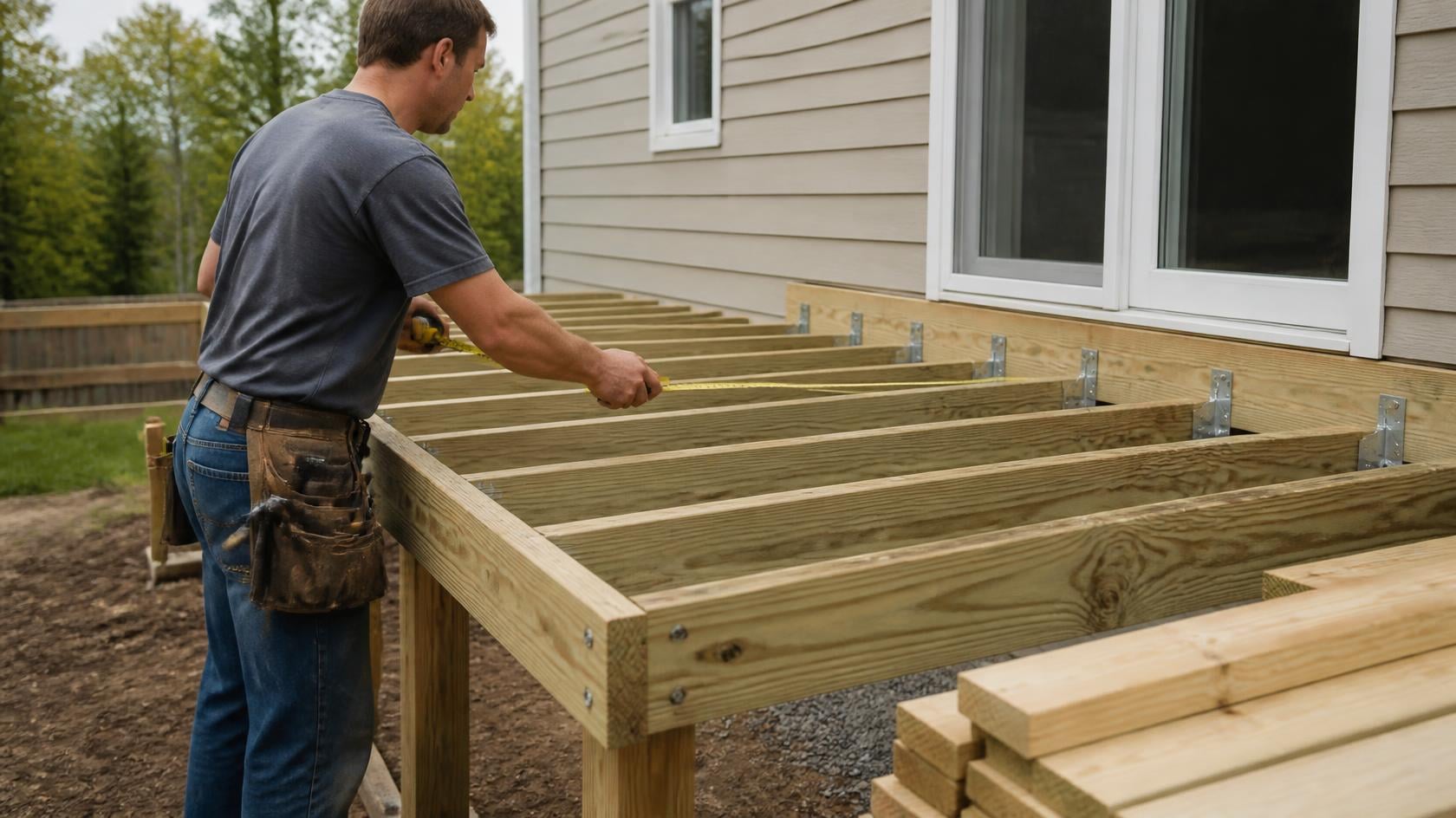
Photos help you rank. They aren’t decoration. The average deck-builder listing has about 36 photos. Decks are the most visually persuasive product in the trades, and we still onboard companies with four blurry phone shots. Upload finished builds, in-progress framing and before-and-afters. Shoot the framing stage especially. That’s what convinces a homeowner you build properly instead of just finishing pretty. If your profile is sitting at ten photos, you’re passing up the easiest advantage in the trade.
And your website has to be secure. NADRA found nearly half the deck-builder websites linked from Google listings weren’t running HTTPS. That hurts trust and it kills conversions. It’s also a one-afternoon fix, so there’s no excuse.
We handle the profile and review work as part of our local SEO services.
How do you grow a deck building business online?
Once the profile is sorted, growth comes from content that matches how homeowners search for decks. That’s very different from how they search for a plumber. Deck buyers research for weeks. They search by material, by structure type and by cost long before they search for a contractor.
That points to three kinds of pages almost nobody in the trade bothers to build:
- Material pages. Someone searching “Trex deck cost” and someone searching “cedar deck vs composite” are at different budgets and different stages. Give each its own page and you catch intent that a competitor’s single “Services” page can’t.
- Permit and code content. Under the International Residential Code, a deck generally needs a permit once it’s more than 30 inches above grade, attached to the house, or over about 200 square feet. The exact trigger varies by jurisdiction. Homeowners search this all the time, and a page explaining your county’s real threshold ranks, builds trust and pre-qualifies the reader before they ever call for an estimate.
- Repair versus replace. This one’s regional. Around our Washington office and up and down the Puget Sound corridor, the wet season leaves plenty of older cedar and pressure-treated decks with rot at the ledger and joist ends. So “deck repair” and “deck resurfacing” pull real volume next to new builds. In drier markets that split barely exists. Check your own area first.
More pages won’t save you. A deck company with five useful pages will outrank one with twenty-five thin ones every time. If you’d rather hand off the technical side, that’s our local SEO services and website development.
Troy Mobley, a contractor client out of the Puyallup area, summed up the organic side in his Google review: organic marketing is the best way to build a business, and it took someone who had it dialed in. I agree. It builds on itself over time, but it won’t happen by itself.
How can a small deck company compete with bigger contractors?
Be more specific than they can afford to be. Big general contractors and regional remodelers rank on domain strength and budget, but their content has to cover every trade they sell. Yours only has to cover decks. And specificity is what Google’s ranking systems and AI assistants reward now.
Start with the category. A GC filed under General Contractor is fighting over a broad, crowded search. You, filed under Deck Builder, are up against maybe a dozen businesses in your service radius.
Next, out-review them locally. A national brand might have thousands of reviews across hundreds of locations and just twelve in your city. The map pack reads local counts.
Last, publish what they won’t. No regional remodeler is going to write about the framing detail on a sloped-lot deck in your county. You can. That kind of first-hand content is what gets cited in AI answers.
One thing people ask us all the time: is SEO slower than ads? Yes. Organic and map pack work usually takes two to four months to move in a meaningful way. If you need appointments on the calendar sooner, that’s what our deck contractor marketing program is for. It’s paid campaigns billed per booked estimate. Most clients run both, with ads carrying the first season while SEO builds underneath.
Where we work on SEO for deck contractors
We work with deck and outdoor-living contractors in every state. Most of them cluster around our Washington office (south King County, Seattle, Tacoma, Puyallup) and down into Portland. Outside the Northwest, our deck and contractor SEO clients are in Orange County and Los Angeles, Raleigh and Charlotte, Atlanta, Nashville, Dallas and Houston, Denver, and Phoenix.
Washington, United States
Phone: (928) 482-6963
Deck and outdoor-living contractors, all 50 states. Northwest clients in Seattle, Tacoma, Puyallup and Portland.
Frequently asked questions
Why is my deck company not showing up on Google?
Nine times out of ten it’s an unclaimed listing, a primary category that’s too broad, or too few reviews. In NADRA’s look at 7,249 deck-builder listings, 29% were unclaimed and a third had zero reviews. Fix those before you spend more money.
How do deck contractors rank in the local map results?
Google weighs relevance, proximity and prominence. Pick Deck Builder as your primary category, hide your address and set a service area if you go to customers’ homes, load up on real project photos, and get well past three reviews. You can’t do much about proximity, but the rest you earn.
How do you grow a deck building business online?
Write for the way homeowners research decks: material comparisons, cost pages, permit-threshold explainers. One generic services page won’t cut it. Keep the website secure and fast, keep the Google profile maintained, and remember that five solid pages beat twenty-five thin ones.
Do you specialise in outdoor living and deck companies?
Yes. Deck builders, patio and enclosure installers and outdoor-living contractors are a core vertical for us, along with other trades. We only work with contractors (no restaurants, no retail), so our campaigns already account for seasonal demand and material-based searches.
How is working with a niche agency different from a general one?
A general agency learns your trade on your dime. We already know deck searches split by material, that permit thresholds drive volume, and that the primary GBP category choice matters more than most on-page tweaks. You’ll see it in how fast the first ninety days move.
Want to know where your deck company sits in the map pack right now? Get in touch and we’ll check.